
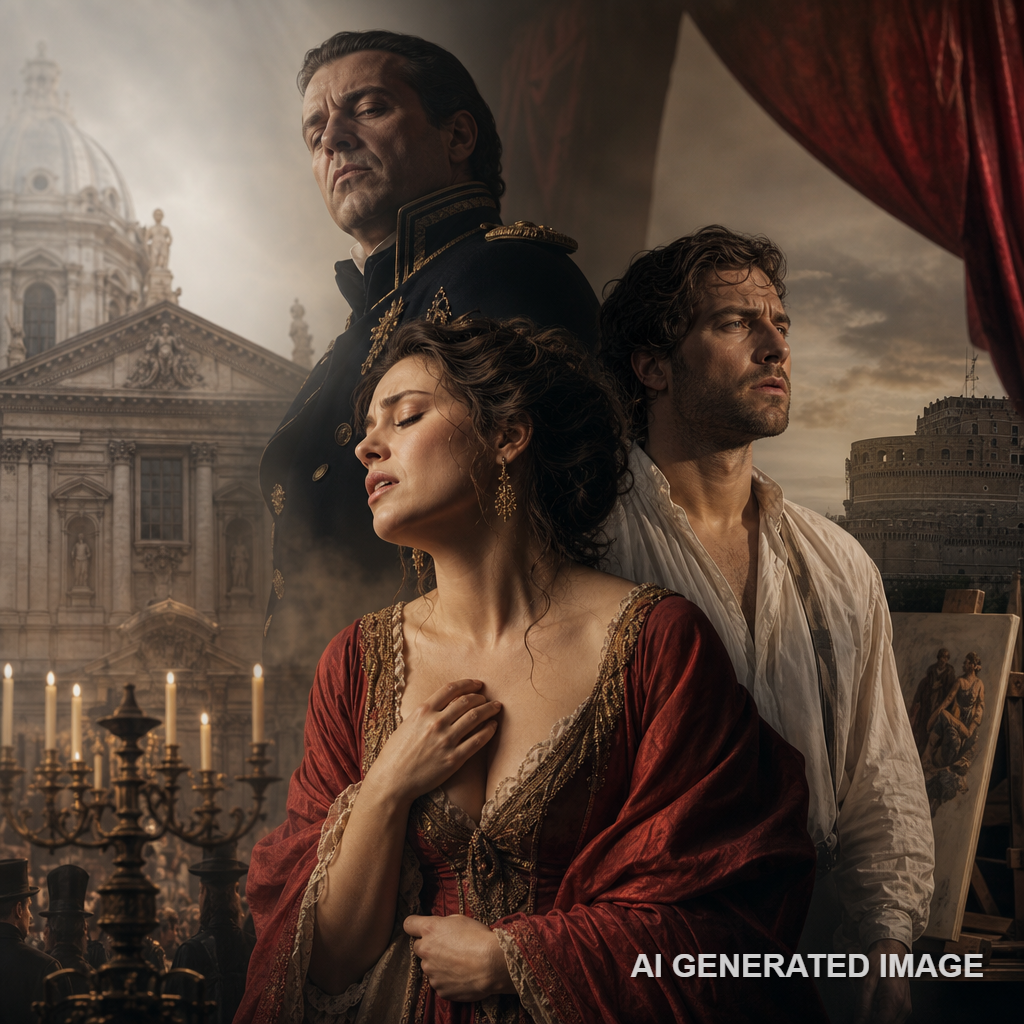
A first Tosca opera can feel intense, even when you know little about opera. This Tosca opera rewards a small amount of preparation, because its political danger, jealousy and religious spectacle unfold within one day in Rome.
Key points
- Three acts unfold during one day in June 1800.
- Premiere: Rome, 14 January 1900.
- Arrive approximately 30 minutes before the start.
The Story Behind the Tosca Opera
Puccini’s three act opera premiered at Rome’s Teatro Costanzi on 14 January 1900. Luigi Illica and Giuseppe Giacosa wrote the libretto after Victorien Sardou’s drama La Tosca. The action moves through three recognisable places: Sant’Andrea della Valle, the Palazzo Farnese and Castel Sant’Angelo.
At the centre stand three sharply different figures. Floria Tosca is a celebrated singer, emotionally sincere but vulnerable to manipulation. Mario Cavaradossi is a painter, a republican sympathiser, and a brave yet impulsive man. Baron Scarpia, the chief of police, turns public authority into private power.
The plot develops through a clear chain of pressure. Cavaradossi helps the escaped prisoner Cesare Angelotti, which exposes his political danger. Tosca notices signs that suggest another woman, and Scarpia uses her suspicions to control the investigation. His actions lead to torture, while Tosca’s desperate bargain with him brings the final tragedy.
That conflict makes the work more than a tragic romance. Republican resistance, authoritarian rule, religious ceremony and artistic identity all shape the evening. The opera places intimate suffering inside a politically unstable Rome.
Listen for These Musical Turning Points
You do not need music theory to follow Puccini’s design. Listen instead for contrasts. Scarpia’s music often feels threatening and restless, while Tosca’s exposed moments use broad, lyrical lines. The orchestra can signal danger before a character understands what is happening.
“Recondita armonia” introduces Cavaradossi’s artistic and romantic world. It also places his personal feelings beside the political risk surrounding Angelotti’s escape. Later, “Vissi d’arte” pauses the action while Tosca asks why devotion and goodness have not protected her from suffering.
The Act I Te Deum creates one of the clearest clashes in the score. Sacred choral writing and church bells suggest public ceremony, while Scarpia’s private desire reveals corruption beneath that display. The ominous opening chords prepare the audience for his arrival and for the change in atmosphere.
Intimate arias and large public scenes continually change the scale of the drama. Near the execution, Cavaradossi sings “E lucevan le stelle”, a farewell to love and life rather than a conventional romantic declaration. You can follow the emotional direction without identifying every musical detail. For a performance listing and practical information, Tosca Opera details can help you plan the evening.
Practical Preparation for the Theatre
Choose smart, comfortable clothing rather than assuming formal evening wear. Dress expectations differ by venue and country, so ticket information and house rules should guide you. Comfort matters during a long performance, especially when the plot grows tense and the audience remains focused.
Arrive approximately 30 minutes before the stated start time. That buffer gives you time for ticket checks, cloakroom arrangements, seating and a quick look at the synopsis. It also prevents the first church scene from becoming your orientation period.
Latecomers may wait until a suitable pause before entering, depending on the venue’s policy. An interval may divide the performance, but its timing and length require a check of the programme or ticket information. Keep your ticket available, since staff may need to direct you to the correct seat.
If the performance uses another language, check for surtitles, projected translations or a translated synopsis before arrival. Options vary. Read a short plot outline first, then use the surtitles to follow immediate decisions instead of translating every line word for word.
Remember the central triangle: Scarpia wants Tosca, Tosca wants Cavaradossi’s safety, and Cavaradossi wants freedom and dignity. That simple structure keeps the action clear when a line or phrase escapes you.
Leave Room for the Emotional Shock
Prepare the sequence, not every detail. Know who Angelotti, Cavaradossi, Tosca and Scarpia are, arrive 30 minutes early, and check the venue’s translation and interval information. Then let the music reveal how political violence turns private choices into irreversible consequences.
Other Notable Tosca Productions and Recordings
Beyond the original 1900 premiere, Tosca has remained one of the most frequently staged operas worldwide, with productions ranging from traditional period settings to modern reinterpretations that relocate the action to different eras while preserving the core political tension.
Historic recordings often serve as reference points for new listeners. Performances featuring legendary sopranos in the title role are frequently discussed for how they balance Tosca’s vulnerability with her strength, particularly in the demanding “Vissi d’arte.”
If you’re exploring recordings before attending a live performance, listen for differences in tempo and orchestral balance between interpretations. Conductors vary widely in how they shape the tension of Act II, which can significantly change the emotional impact of the confrontation between Tosca and Scarpia.
Film adaptations and staged-for-television versions also exist, offering a useful way to see the visual staging of key moments like the Te Deum or the final scene at Castel Sant’Angelo, though nothing fully replaces the immediacy of a live theatre performance.
Key Takeaways
Tosca unfolds across a single day in June 1800, moving through three distinct Roman locations that mirror the story’s escalating danger. Understanding this compressed timeline helps you follow the urgency driving each character’s decisions.
The three central figures each want something incompatible: Scarpia wants control over Tosca, Tosca wants Cavaradossi’s safety, and Cavaradossi wants his freedom and principles intact. Keeping this triangle in mind makes the plot easy to follow even during dense or unfamiliar passages.
Musically, pay attention to contrast rather than technical detail — Scarpia’s restless, threatening lines against Tosca’s lyrical outpourings, and the false grandeur of the Te Deum against the corruption it conceals. The arias “Recondita armonia,” “Vissi d’arte,” and “E lucevan le stelle” mark the emotional high points of each act.
Practically, arrive about 30 minutes early, dress for comfort rather than assumed formality, and check the venue for surtitles or a translated synopsis if the performance isn’t in your language. These small preparations let you focus on the drama rather than logistics once the curtain rises.
Author Profile

- Meet our expert author, Daniel Thompson, who is passionate about traveling and exploring new places. With years of experience in the travel industry, Joanna has visited some of the most beautiful destinations in the world and loves to share her experiences with others. As a regular contributor to TongTrip.com, Joanna provides readers with inspiring travel articles, helpful guides, and insightful travel stories from our community of users. She also helps travelers plan their trips from start to finish using our travel planning tool. Join the TongTrip community today and share your travel experiences with Joanna and other like-minded travelers.
Latest entries
 Travel experiencesAugust 20, 2026Your first Tosca evening. How to prepare for the performance?
 UncategorizedJune 30, 2026How to Book and Enjoy The 3 Tenors and Soprano Concert in Rome?
 Travel inspirationApril 17, 2026Best opera in Rome: 5 performances and venues worth choosing
 Travel experiencesMay 29, 2024What Are Rwanda Gorilla Tours Like?


